
One of the most challenging current issues here in California is the impact of artificial intelligence and chatbots on the existing and future workforce. Fears of computers and bots replacing high paying white collar jobs has led to daily columns in outfits such as the New York Times and the Atlantic with dire and often dooms day predications.
What is the true impact of these new technologies? What impact if any has already occurred? Most importantly, what can job-seekers and employees do to insulate themselves from this disruption or leverage the change for enhanced roles with more rewarding and secure jobs and possibly higher pay? Finally, what is the role of public policy and the government sector in managing this transition?
This is a major area of research for the Golden Research Institute. This topic could dramatically impacteffect the technology sector not only in the Silicon Valley but throughoutthought out the World.
Current Impact
The first step is to analyze any existing impact of AI on the workforce.
A good proxy for this is the unemployment rate for recent college grads in comparison to the overall unemployment rate in similar sectors. If we run with the hypothesis that the current AI chatbots (e.g., ChatGPT, Gemini, Grok) are replacing entry level analyst work then it would stand too reason that you would see the AI impact first in these entry level roles.
In July of 2025, 58% of recent college grads are still looking for a job. That is down from a traditional percentage of 25%. In an era where overall unemployment remains low, this could be a canary in the calming in terms of initial impacts of AI.
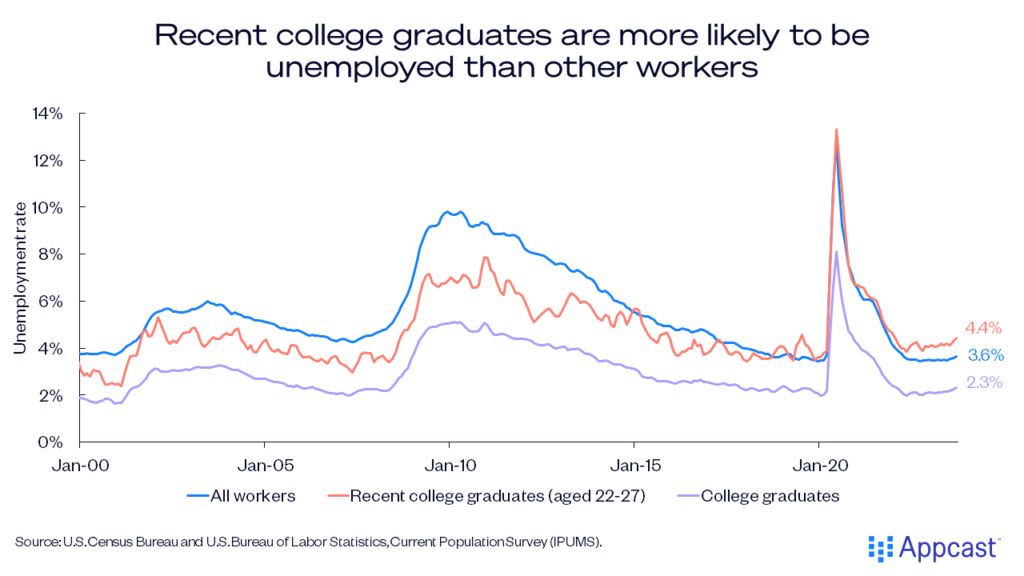
As you can see, there exists an alarming pattern of unemployment and underemployment with entry level workers.
Many researchers have noted how the performance of AI against various benchmarks has increased rapidly in recent years. The graph below, from the “Artificial Intelligence Index Report” published by the Human AI Institute at Stanford University, enumerates a few of these from straightforward tasks like Image Classification, which the best AI became better than the average human about ten years ago to English language understanding, and now PhD level science.

This is impressive, but it becomes economically impactful when we start talking about not just AI being able to take on tasks, but AI taking on entire jobs. That is the frontier we have hit in the last 12 months where prominent business people and AI experts have begun to proclaim both that AI is at or near the level of performance to replace entry-level coders, financial analysts, and several other white-collar positions as well as “replace entire job categories”, as well as poised to take their jobs.
In light of these claims, employment reports for recent graduates are quite alarming. For example, In July of 2025, 58% of recent college grads are still looking for a job. That is down from a traditional percentage of 25%. In an era where overall unemployment remains low, this could be a canary in the calming in terms of initial impacts of AI.
In light of this trend, the GRI is partnering with schools in California to dig deeper into this data to understand:
- Which industries and students are most impacted
- What trends we are also seeing on salary, under-employment and career progression
- And how all of these trends are progressing in real-time
New AI Jobs
One other area that needs to be investigated is wherein where AI is creating new jobs.
Is this enough to offset the job losses? What skills are necessary for these new roles? What is their pay and prospects for both new entrants and existing workers?
We have all seen the incredible pay packages that Mark Zuckerberg and Metaart META has lavished upon some of the top AI researchersresearches in the world, with packages. Some of these new AI “hot shots” are rumored to be up togetting over $100M per year!
The AI revolution is working out great for some, but what is the overall effect AI is really having on creating jobs? Is this enough to offset the job losses? What skills are necessary for these new roles? What is their pay and prospects for both new entrants and existing workers?
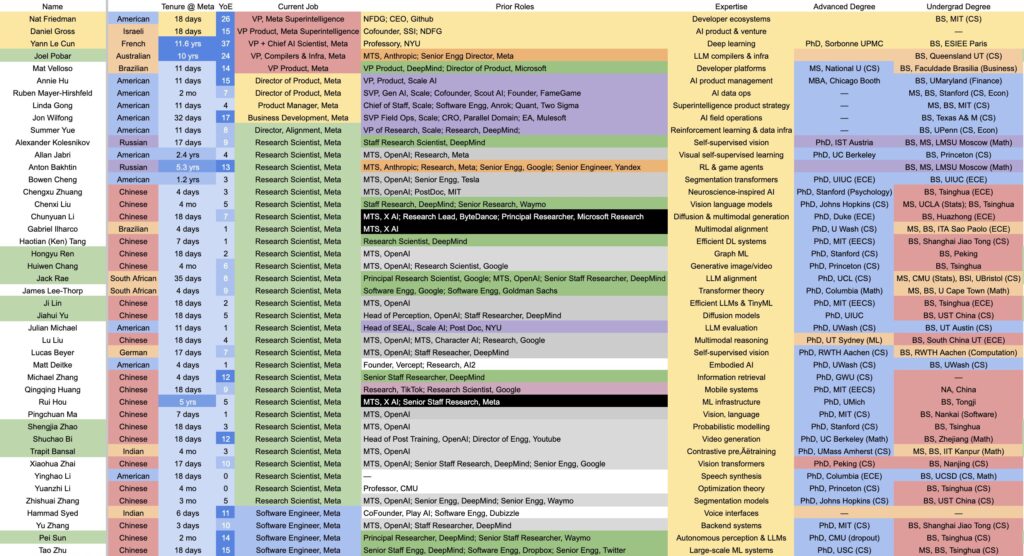
As you can see, there seems to be certain folks that are making it big with AI. Maybe not that dissimilar to how high level sporting talent like Steph Curry, Messi, and Patrick Mahomes get massive contracts. But what is the effect on the median worker? And what skills are necessary? Everyone cannot end up with a machine learning PHD so some perspective is necessary to understand the broader implications.
Public policy in AI
AndSo what is the role of the governmentof government in all of this? This is a key question we hope to answer at the Golden Research Institute. There are several areas public policy can play a role:
- Legislation – new laws that address AI and its impact on the workforce. This could be a partapart of other legislation that looks at AI security and safety with an eye at avoiding some of the scary “sky n
- et” aspects of AI and bots.
- Regulation – implementing new and existing workforce laws in relation to AI. This raises the question on the role of federal versus state authorities in such regulation as well as how to police other countries.
- International treaties and cooperation – countries and multinational bodies coming together to address AI and its role in society.
This is a key question we hope to answer at Golden Research Institute.
The Path Forward
Golden Research Institute is digging into each of these areas, trying to help individuals, schools, governments, and businesses:
- Find and create the data sources and metrics to measure the impacts of AI on the economy and the work force as it is happening
- Identify opportunities to support the current and upcoming workforce in ensuring they are well-positioned amidst the changes that AI are bringing to our economy and the workplace
- Workings with schools and universities to help train the workforce of tomorrow
- Evaluating and proposing policies to help ensure AI has a positive and beneficial impact for all as it fundamentally changes the world we live and work in over the next decade and beyond.
If you are interested in learning more about Golden Research Institute and how you can help, please contact us at info@goldenresearchinstitute.com.
